

 English
 Français
 Deutsch
 Italiano
 Русский
 Español
 简体中文
简体中文 हिन्दी
 日本語
日本語
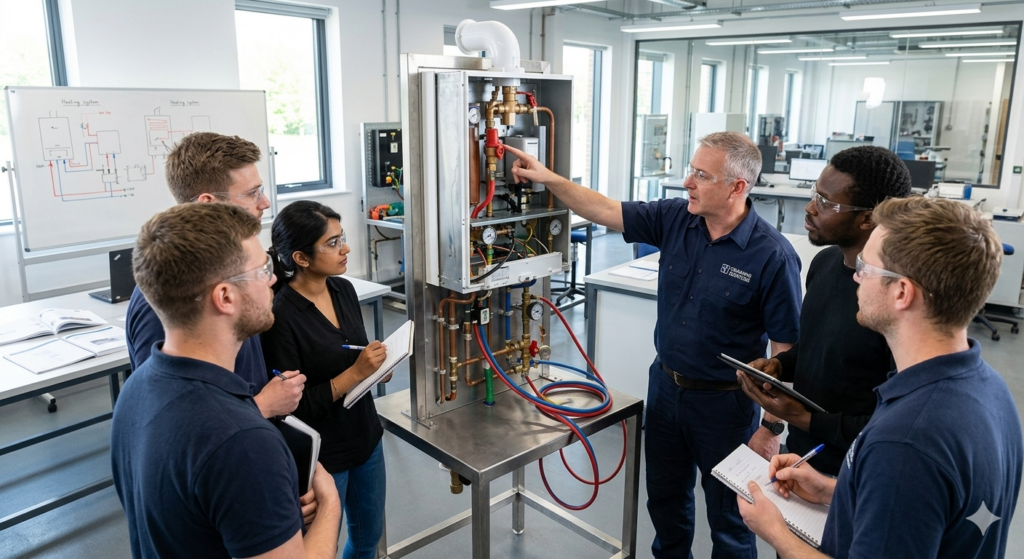
With millions of gas boilers across the UK and a growing need for experts to help transition homes toward lower-carbon heating, there has never been a more exciting time to enter the industry. Becoming a gas safe registered engineer is a rewarding career path that offers stability, good earning potential, and the chance to solve real problems for homeowners every day.
However, because you are dealing with potentially dangerous systems, the path to qualification is rigorous. Here is everything you need to know about gas safe engineer training and the steps required to join the official register.
The path to becoming a gas safe registered engineer
There isn’t just one way to enter the trade. Your journey will depend on your current experience and how much time you can dedicate to your studies.
For those starting from scratch, the most common route is a managed learning programme (MLP). These courses are designed specifically for “new entrants” and combine classroom learning with hands-on practical experience. If you are already a qualified plumber, you might find a “fast-track” route that builds on your existing knowledge of pipework and water systems.
How long does it take to become gas safe registered?
One of the most common questions for prospective trainees is how long does it take to become gas safe registered?
On average, it takes between 6 months and 2 years to fully qualify.
- Fast-track or intensive courses: These can often be completed in around 25 to 30 weeks, but they require a full-time commitment.
- Apprenticeships: These typically take 2 to 4 years but allow you to earn while you learn, providing a much deeper level of on-the-job experience.
The variation in time usually comes down to how quickly you can complete your “portfolio of evidence,” which involves working alongside a qualified mentor on real-life jobs.
Step-by-step: Gas safe engineer training
To reach the standard required for registration, your gas safe engineer training will follow a specific sequence:
- Theoretical learning: Understanding the science of combustion, ventilation, and the laws governing gas safety.
- The portfolio: You must work under the supervision of a registered engineer to document a specific number of hours and a variety of tasks, such as installing boilers or servicing fires.
- The ACS assessment: Once your portfolio is approved, you sit the Accredited Certification Scheme (ACS) exams. This is the final hurdle to prove you are competent.
Obtaining your gas safe qualification
The core gas safe qualification you need is the CCN1 (Core Domestic Natural Gas Safety). Once you have this, you can then add “elements” or categories for specific appliances. For example, if you want to work on central heating, you will need the CENWAT element. If you want to work on gas cookers, you will need the CKR1.
It is important to remember that a gas safe qualification isn’t for life. You must retake your ACS assessments every five years to ensure you are up to date with current safety legislation and new technologies.
How do I become gas safe registered with the official body?
Once you have passed your ACS assessments, you might wonder, how do I become gas safe registered officially?
Passing the exams doesn’t automatically put you on the register. You (or your employer) must apply to the Gas Safe Register and pay the registration fee. Once accepted, you will receive your licence number and your Gas Safe ID card. You are then legally allowed to work on gas appliances in the UK.
Growing your business with Rated People
Getting your ID card is a huge milestone, but the next challenge is finding a steady stream of work. This is where Rated People becomes an essential partner for newly qualified engineers.
Building a reputation from scratch can be tough, but our platform allows you to showcase your new credentials and start collecting verified reviews from your very first customers. When homeowners see that you are a gas safe registered engineer with positive feedback from people in their own neighbourhood, it builds instant trust. It allows you to spend less time worrying about marketing and more time on the tools, helping you grow your business at a pace that suits you. For many pros, Rated People is the bridge between finishing their training and running a successful, busy heating company.
A career for the future
While the industry is changing, the need for skilled, safe, and professional heating engineers is only going to increase. Whether you are installing a traditional boiler or branching out into hybrid systems, your training is the foundation of a lifelong career.
Log in to your Rated People account today to find local leads and showcase your expertise to homeowners ready to hire.
Read the full article here